
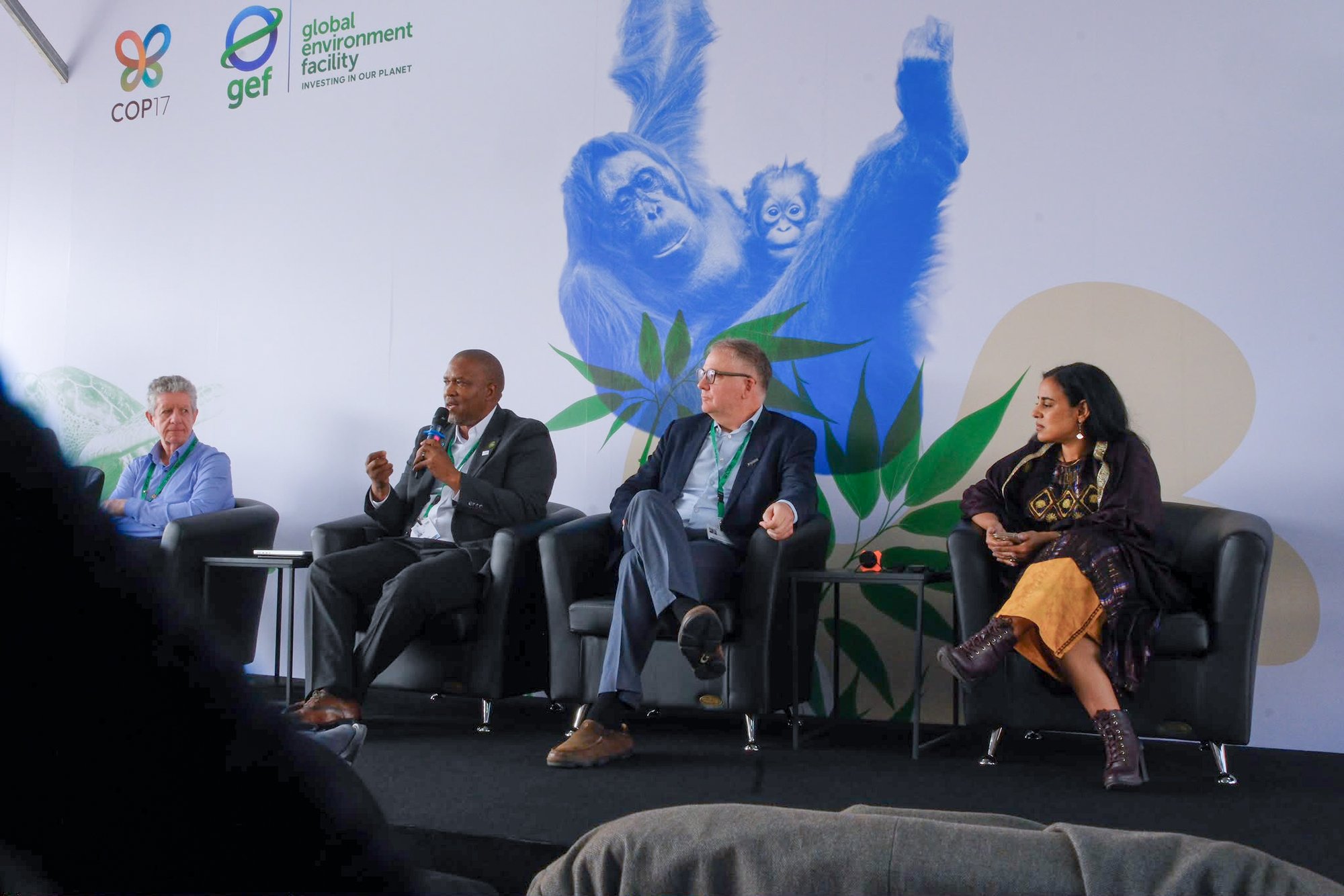
On the morning of 22 October 2026, Dr. Mariam Wallet Aboubakrine, President of Association Tinhinan and Co-Principal Investigator and Co-Executive Director of the Ărramăt Project, joined a Global Environment Facility (GEF) panel at CBD COP17 on Indigenous Peoples, data and artificial intelligence. She thanked the GEF Secretariat, its Scientific and Technical Advisory Panel (STAP) and its Independent Evaluation Office (IEO) for placing Indigenous Peoples’ science on an equal footing, and welcomed the fourfold increase in direct access for Indigenous Peoples, to 100 million dollars under GEF-9, before turning to data as the next step.
She presented the Ărramăt Project, whose name is a Tamasheq word for the well-being of everyone and everything together. The six-year partnership, funded with 24 million Canadian dollars by Canada’s New Frontiers in Research Fund, brings more than 70 Indigenous governments and organizations together with universities, around some 140 place-based projects designed and led by Indigenous partners in about 24 countries. She gave the example of the Potato Park near Cusco, where partners Asociación ANDES run an artificial intelligence system that speaks Quechua, works offline on solar power and belongs to the communities.
She explained how Ărramăt’s data plan grew from Ethical Space and is anchored in Indigenous Peoples’ own laws and in the UN Declaration on the Rights of Indigenous Peoples. She described the project’s “Three Colours” approach: red for what a community keeps, yellow for what the network watches over because of biopiracy or intellectual property risks, and green for what is shared openly. Holders colour their own data, unlabelled data is treated as red, and nothing red or yellow is used to train any model.
Her central message was that AI can help reach the Kunming-Montreal targets in narrow and useful ways, but that the real questions are who owns the machine, who holds the keys to the data, and who the system answers to. She closed with concrete recommendations for the GEF Indigenous Peoples Policy, going beyond free, prior and informed consent.

- Make the CARE principles (collective benefit, authority to control, responsibility and ethics) a condition, alongside free, prior and informed consent, for any GEF-funded data or AI activity touching Indigenous territories or knowledge.
- No model trained on Indigenous data without documented consent, and disclosure of where training data comes from.
- A data-tiering rule with community control as the default: unlabelled data is protected, and holders can withdraw at any time.
- Direct funding for community-owned infrastructure: hardware, solar power, local training and the people who run the systems.
- Assess AI’s physical footprint (energy, water and minerals, which often land on Indigenous territories) before counting it as a contribution.
- Dr. Mariam Wallet Aboubakrine — President, Association Tinhinan; Co-Principal Investigator and Co-Executive Director, Ărramăt Project